
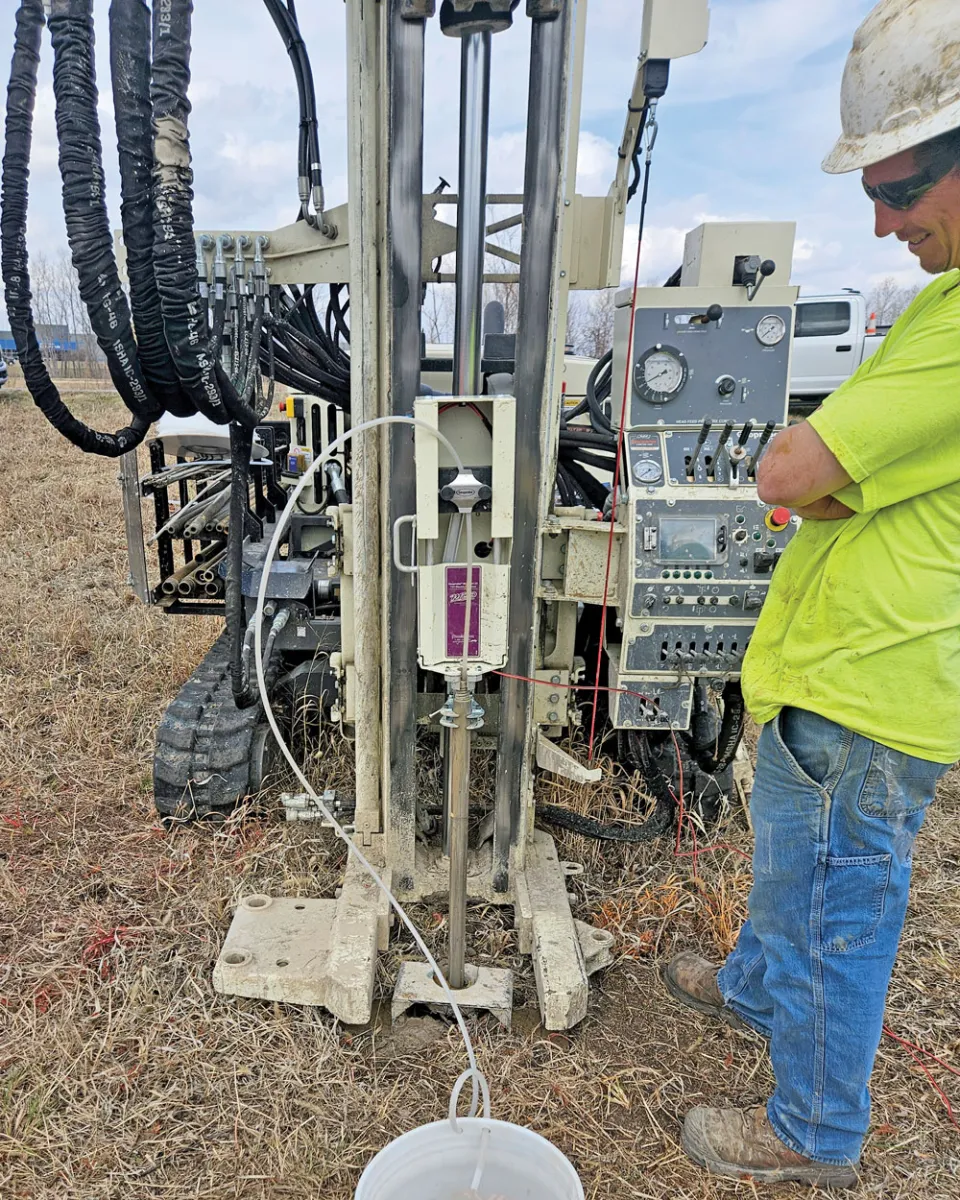
PFAS Contamination
Confidence in Every PFAS Sample
Tooling tested for PFAS sampling, clear field procedures, and support from people who’ve worked through the details.
PFAS contamination has become a major concern at sites across the country. Labs can now detect these compounds in the low parts-per-trillion range, so the smallest source of cross contamination can compromise a sample, and your reputation with it. PFAS sampling leaves no room for guesswork.
Geoprobe® has tested its soil and groundwater sampling tools for PFAS and published the results, so you can start every PFAS project knowing your tooling won’t be the problem.
What Is PFAS Contamination?
PFAS (per- and polyfluoroalkyl substances) are a large family of synthetic fluorinated chemicals used in many industrial and commercial products. Their carbon-fluorine bonds are among the strongest in chemistry, so they barely break down. They also dissolve readily and travel easily through groundwater.
Major sources include aqueous film-forming foam (AFFF), used for firefighting and fire training at military bases, commercial airports, and some municipal fire departments. PFAS also show up in everyday products: nonstick cookware, PTFE plumber’s tape, waterproof clothing, and water- or stain-resistant coatings.
Federal limits are extremely low and still evolving. In April 2024, EPA set the first enforceable national drinking water standards for six PFAS, with limits of 4.0 parts per trillion (ppt) each for PFOA and PFOS. EPA has since proposed two changes: keep the 4.0 ppt limits for PFOA and PFOS while letting water systems request two more years to meet them, and remove the limits for four other PFAS. PFOA and PFOS are also designated hazardous substances under CERCLA (Superfund), and on August 18, 2026, the D.C. Circuit Court of Appeals denied petitions challenging that designation. With labs now detecting many PFAS compounds at low single-digit ppt levels, every sample has to be clean. See EPA’s latest PFAS updates →
Why PFAS Sampling Is Different
At these detection levels, ordinary materials become contamination risks: Teflon® tape, waterproof rain gear, even the wrapper from lunch. Every person, product, and tool that touches the sample matters.
Tooling Tested for PFAS Sampling
You don’t have to wonder whether your tooling is a source of PFAS. We’ve had it tested:
- Soil liners. Geoprobe® clear PVC soil liners, including the lay-flat liners used for sonic sampling, were analyzed by Jennifer Field, Ph.D., and her research team at Oregon State University. They tested nondetect for all 52 PFAS compounds analyzed, including PFOA and PFOS.
- Groundwater sampling tools. The Hydraulic Profiling Tool (HPT), the 175GWP groundwater profiling system, the SP16 and SP22 screen point groundwater samplers, and prepacked well screens all tested nondetect for each of the 36 PFAS compounds on the Wisconsin PFAS analyte list.
Download the PFAS Technical Bulletins for the full equipment list, test procedures, and lab reports.
Latching Screen Point Samplers for Higher-Quality Samples
Screen point (SP) groundwater samplers have been standard equipment for direct push operators since the 1990s. They deliver a protected screen to depth, then expose it to the formation.
Our latching SP samplers go a step further for PFAS sampling:
- Seal off the zone you’re sampling with a secure seal inside the pumping zone.
- Collect a cleaner sample using a mechanical bladder pump or other sample line.
- Match your project with three sizes: SP16, SP19, and SP22.
Built for the Whole Crew
- Drillers get tooling they can trust and clear procedures that make clean sampling routine.
- Operations managers get tested tooling options and documentation to share with clients and regulators.
- Owners get a way to win PFAS work and protect the company’s reputation for reliable data.
PFAS Sampling Procedures in the Field
Follow these PFAS sampling procedures to protect sample integrity:
- Use standard steel tooling with confidence. The steel components of Geoprobe® soil and groundwater samplers don’t contain PFAS.
- Keep PTFE off sample-contact surfaces. Don’t use Teflon® tape or PTFE joint compound on any joint or fitting that touches the sample.
- Choose the right liners and tubing. Use clear PVC soil liners for soil sampling and HDPE or polypropylene tubing for groundwater sampling. Never use Teflon® liners or tubing.
- Swap in PFAS-safe seals. The DOD recommends silicone-based plumber’s paste and O-rings in place of Teflon® products.
- Decontaminate with approved products. DECON 90 contains PFAS components, so use soap and water approved for PFAS sampling.
- Run field rinsate samples periodically on tools and soil liners. Use PFAS-free water and HDPE or polypropylene bottles supplied by your lab, never tap or bottled water.
- Watch what you wear and bring. Change gloves often, and keep waterproof clothing, coated food wrappers, and similar items away from samples.
PFAS guidance keeps evolving as the industry learns more about sampling, analysis, and remediation. Always follow your project’s and state’s current requirements.
Target Your Sampling Intervals
Because PFAS move readily in groundwater, knowing where water flows helps you sample in the right place. The Hydraulic Profiling Tool (HPT) logs formation permeability in situ, and it tested nondetect for PFAS, so you can choose sampling intervals with confidence before you set a screen.
Support When You Need It
Our team helps troubleshoot PFAS sampling techniques and tooling questions, and a live person answers the phone. Most parts ordered before 2 p.m. CST ship the same day, so the right liners, tubing, and samplers reach your crew when the job starts.
Tested tooling and proven procedures from Geoprobe® help you collect PFAS samples you can stand behind.
Find the Right Tooling for Your PFAS Work – Give Us a Call
Have a question about PFAS sampling procedures or tooling? Tell us about your project, and we’ll help you find the right setup. Less time worrying about cross contamination means more time with your family.
Talk with a Geoprobe® expert or call (785) 825-1842.
Everything has to be clean and you’re constantly changing out gloves. You have to be very detail oriented and realize that many products we use or wear may have PFAS in it — you need to be very aware of cross contamination,
Related Articles

Mobile Environmental Analytical Inc. relies on Geoprobe's East Coast Service Center for fast, expert repairs and responsive support that keep its drilling fleet operating efficiently and minimize downtime in the field.
ID: 14891 | Date:
Coastal Environmental Solutions relies on the Geoprobe® 6011DT to handle tight, low-clearance urban sites, giving them the flexibility to take on challenging projects and expand their drilling capabilities.
ID: 14825 | Date:
Phoenix Group relies on the Geoprobe® 6712DT to handle tight, low-clearance sites, making it easier to take on more environmental work with efficient, versatile drilling.
ID: 14824 | Date:
Chase Environmental turned their Geoprobe® 7822DT into a rock drilling solution, cutting costly subcontracting and unlocking more profitable, versatile work in the field.
ID: 14823 | Date:
Ace Dewatering relies on the Geoprobe® 7822DT to handle geotechnical and environmental work alongside dewatering, bringing versatility, access, and efficiency to every project.
ID: 14822 | Date:
Don't see a feature you need? Give us a call.
Our engineers thrive on collaborating with drillers while they innovate new designs.
785-825-1842Drill Rig Telemetry
Ready to minimize downtime?
See rig location, hours, fuel use, and error codes on your phone or computer